From Saharanpur to Ujjain: Action Against Mosques — What Does the Law Say About Encroachment, Development, and Rights?
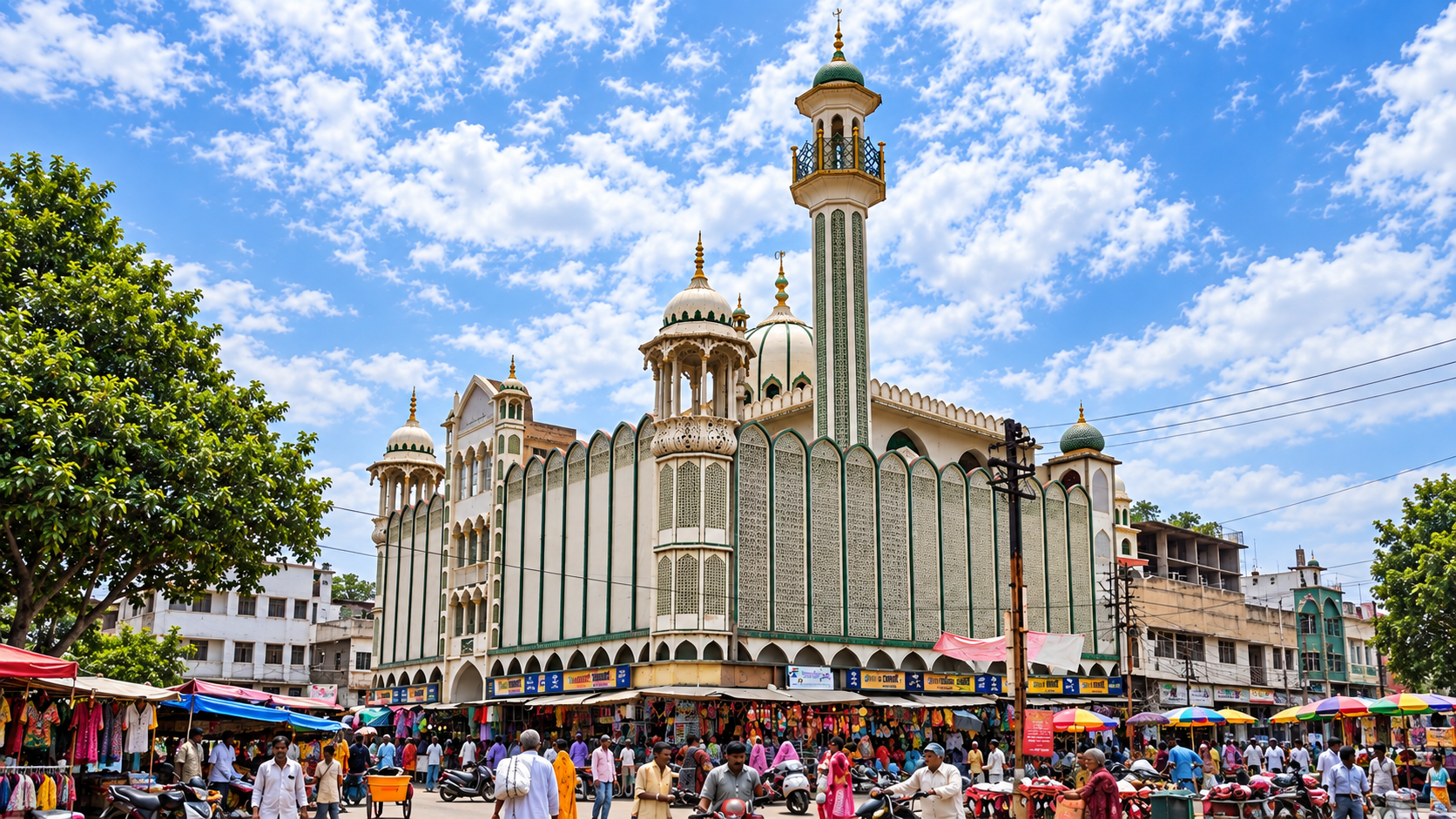
Tension, protests and clashes with the police were witnessed in Ujjain, Madhya Pradesh, on September 28, 2026, over the removal of a portion of the Shahi Mosque. The dispute, which began over road widening, reached the court. People remained gathered around the mosque throughout the night, and stone-pelting took place at some locations the next day. Police used tear gas and mild force. Around 2,500 police and Rapid Action Force personnel were deployed. According to the police, 15 people were detained and FIRs were registered against seven people; some social-media content creators were also among them.
Updated: 29/9/2026, 9:02:10 pm IST
The 60-second brief
- Ujjain: Mosque part removed for road widening.
- Supreme Court: Notice and hearing required.
- Due Process: Several demolitions raised legal questions.
- Targeting Debate: Discrimination claims remain contested.
- Haldwani: Demolition was followed by major violence.
New Delhi | September 29, 2026
An examination of major cases from the past few years; in November 2024, the Supreme Court laid down the procedure for notice, hearing and appeal before demolition
The Ujjain Municipal Corporation had issued notices to the Shahi Mosque management on August 14, August 25 and August 27, 2026, followed by a final notice/order on September 1, 2026. The mosque side challenged this before the Madhya Pradesh High Court. On September 9, 2026, a single bench of the High Court dismissed the petitions. The court also took note of the fact that action had been taken against other religious structures, including temples, under the same road-widening project.
The matter later reached a division bench. On September 28, the court was informed about a settlement between the mosque committee and the municipal corporation, following which the appeals were disposed of. According to reports, there had initially been a proposal to remove around 9.5 feet of the structure, while after the settlement, an agreement was reached to remove around three feet and relocate the minaret within the premises. The court held that the corporation’s written assurances were binding.
Why is Gujarat’s Gir Somnath case also important?
On September 28, 2024, the administration in Prabhas Patan, Gujarat, removed nine Muslim religious structures—including mosques and dargahs—along with 45 other permanent structures. The administration claimed that these were encroachments on government land and that notices had been issued. Around 1,400 police personnel were deployed during the action, and a large number of people were detained. There were also reports of a lathi-charge to disperse the crowd.
In the case of the Pir Haji Mangroli Shah Dargah, a contempt petition later reached the Supreme Court. The petitioners alleged that they received the Collector’s September 27 order on September 29, after the demolition had already taken place. The Supreme Court sought a response from the Gujarat authorities. This allegation, by itself, was not yet a final judicial finding.
Supreme Court’s clear rule: A bulldozer cannot become a “punishment”
On November 13, 2024, the Supreme Court laid down important safeguards applicable across the country in In Re: Directions in the Matter of Demolition of Structures, 2024 INSC 866.
The Court made it clear that the government or administration cannot demolish a person’s property as a form of “punishment” merely because that person is accused of a crime. Such action would be contrary to the rule of law and the separation of powers.
In ordinary cases, a show-cause notice must be issued before demolition. The person concerned must be given the period prescribed under local law or at least 15 days after receiving the notice—whichever is longer—to submit a reply. The Court directed that the notice be sent by registered post and also affixed to the structure. It also prescribed a system under which information about the notice must be sent digitally to the District Magistrate/Collector.
Thereafter, the person concerned must be given an opportunity for a personal hearing, and the minutes of the hearing must be recorded. The final order must explain why the objections were accepted or rejected, why the construction is not compoundable, why the entire structure must be demolished if only a part of it is illegal, and why no alternative to demolition is available.
Thereafter, the person concerned must be given an opportunity for a personal hearing, and the minutes of the hearing must be recorded. The final order must explain why the objections were accepted or rejected, why the construction is not compoundable, why the entire structure must be demolished if only a part of it is illegal, and why no alternative to demolition is available.
After the final order, a period of 15 days should ordinarily be given for judicial appeal/review and for the person to remove the unauthorized portion voluntarily. The demolition must be videographed, an inspection report must be prepared, and a record must be maintained of the police and civil personnel participating in the action.
The Court also said that if a demolition is found to have been carried out in violation of its directions, the officials concerned may face contempt/prosecution and may also be held personally liable for restoration of the property and payment of damages.
However, there is an important exception: if the unauthorized construction is situated on a public place such as a road, street, footpath, railway line, river or water body, or if a competent court has directly ordered demolition, the Supreme Court’s general directions do not apply in the same manner.
Where, then, do questions arise over administrative action?
The issue is not that every demolition should be called “illegal.” In several cases, there is documentary evidence relating to government land, road widening or unauthorized construction. In Ujjain and Shalimar Bagh, court proceedings and road-widening orders exist.
On the other hand, in a case such as Saharanpur, the question is why the administration removed the entire structure so quickly when the court had upheld the eviction but had not passed a separate, explicit demolition order, and how much practical opportunity was available to approach the High Court. The mosque committee raised this very objection, while the administration maintained that eviction meant removal of the premises.
In Mehrauli, after the demolition, the Delhi High Court had to ask the DDA whether prior notice had been given. In Kushinagar, the Supreme Court issued a contempt notice. In Jahangirpuri, demolition was reported to have continued for some time even after the Supreme Court’s status-quo order. These incidents raise genuine questions about administrative accountability.
Are Muslim religious sites being selectively targeted?
Different sides have made different claims on this question, and it would not be appropriate to turn every case into a single conclusion.
In its February 2024 investigation, Amnesty International claimed to have documented punitive demolitions of 128 Muslim-owned properties in Assam, Delhi, Gujarat, Madhya Pradesh and Uttar Pradesh between April and June 2022. According to Amnesty, at least 617 people were affected. Amnesty described these actions as discriminatory and as collective punishment. This was Amnesty’s finding, not a collective ruling by an Indian court covering all 128 cases.
At the same time, the available court record in the 2026 Ujjain case also showed that action had been taken against temples and other religious structures as part of the road-widening exercise, and the High Court did not accept the argument of discrimination. Therefore, interpreting every demolition solely on the basis of religious identity would not be consistent with the evidence.
Even so, repeated allegations of early-morning or night-time action, heavy police deployment, insufficient time to retrieve documents or approach the courts, and immediate demolition in cases involving religious sites are issues that governments and local administrations should examine transparently. The law gives authorities the power to remove illegal construction, but it does not give them the power to bypass procedure or collectively punish a community. That is the central principle of the Supreme Court’s November 2024 judgment.
Violence and police action: Haldwani was the most serious case
Not all of these cases witnessed riots.
In Ujjain in September 2026, stone-pelting and police action took place, but the situation was reported to have been brought under control the same day. In Saharanpur, Shalimar Bagh, Mehrauli and Bengali Market, verified reporting of violence on this scale was not found despite heavy police deployment.
By contrast, in Haldwani on February 8, 2024, the situation turned violent on a large scale after the demolition. Arson and stone-pelting took place, a police station and vehicles were damaged, a curfew was imposed, and shoot-at-sight orders were issued. Details later placed before the High Court referred to six deaths and more than 100 people being injured. Police subsequently made a large number of arrests.
This incident raises another question: in sensitive demolition actions involving religious sites, did the administration adequately use all available options for prior dialogue, mediation and de-escalation? At the same time, it is also a fact that violent stone-pelting and arson are themselves offences under the law, and a demolition dispute does not make them lawful.
Sources & reading notes