UP Census 2027: Online Self-Enumeration to Begin November 16, Door-to-Door Survey from December 1; Citizens to Answer 40 Questions
Preparations for the second phase of Census 2027 have intensified in Uttar Pradesh. Residents will be able to submit their information online from November 16 to 30, followed by door-to-door population enumeration from December 1, 2026, to January 4, 2027. The exercise will collect details related to caste, education, employment and household characteristics.
Updated: 2/11/2026, 2:19:26 pm IST
THE PLANET REPORT
The 60-second brief
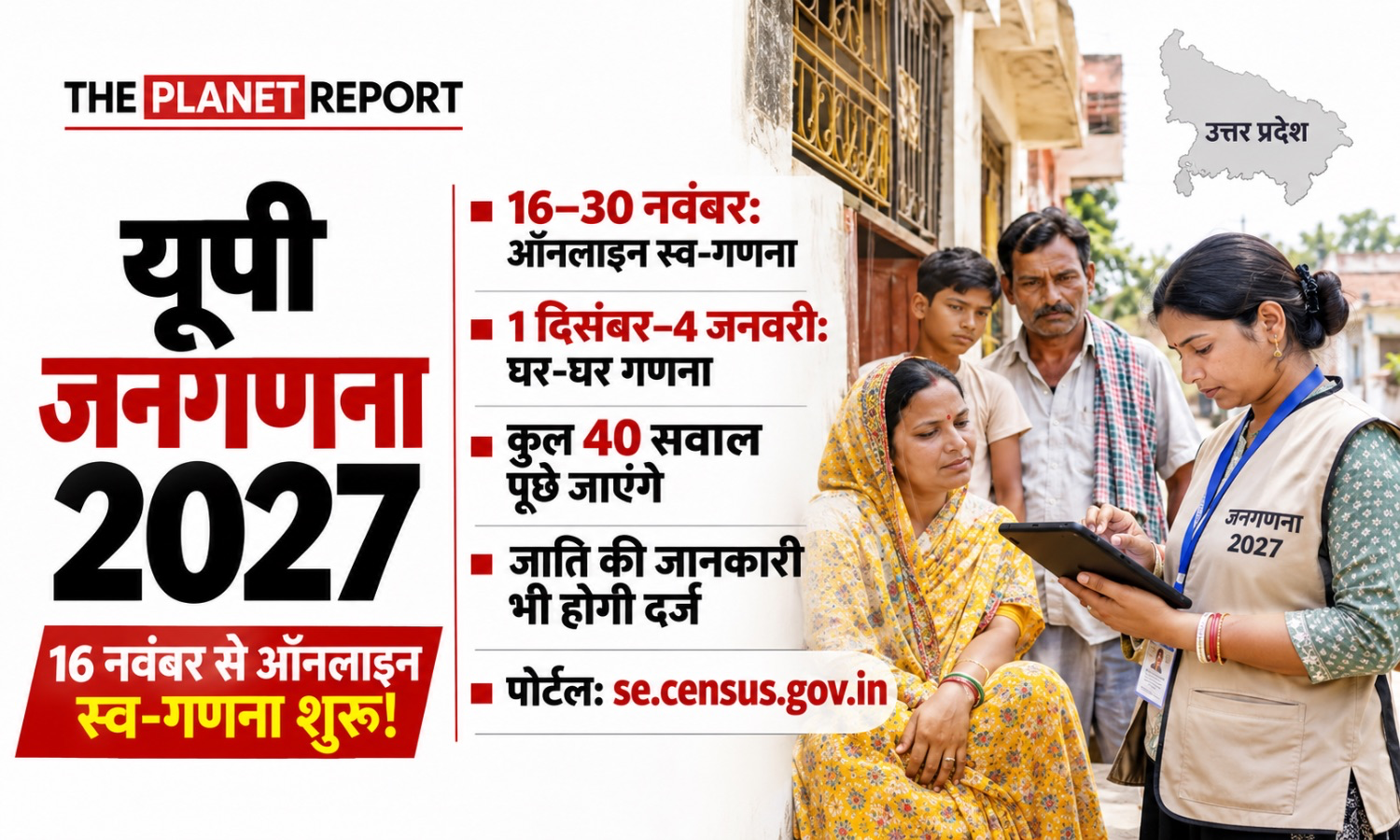
- November 16–30, 2026: Online self-enumeration in Uttar Pradesh.
- December 1–January 4: Door-to-door population enumeration.
- 40 Questions: Details on age, education, employment and family.
- Caste Census: Caste information from all communities will be collected.
- Online Portal: Self-enumeration available at se.census.gov.in.
The schedule for the second phase of Census 2027 has been finalised in Uttar Pradesh. The exercise, which will cover millions of residents across the state, will make extensive use of digital technology to collect population data.
For the first time, citizens will also have the option to submit their household information online through a facility known as Self-Enumeration.
According to the official schedule, online self-enumeration will begin on November 16. Government-appointed enumerators will subsequently visit households in December to collect and verify individual details.
Following a recent notification issued by the Central Government, officials have also clarified the census timeline. The previously announced schedule for Uttar Pradesh remains unchanged.
When Will the Census Take Place?
The population enumeration exercise in Uttar Pradesh will be conducted according to the following schedule:
* November 16–30, 2026: Online self-enumeration will be available to residents.
* December 1, 2026 – January 4, 2027: Government-appointed enumerators will conduct door-to-door population enumeration.
* January 5–9, 2027: Revision and necessary verification activities will take place.
January 5, 2027, has been designated as the reference date for this phase of the census.
What Is Self-Enumeration and How Can Residents Submit Their Information?
Self-enumeration allows an eligible member of a household to submit information about family members directly through the government’s official online portal.
This means residents can provide their details without having to wait for a census enumerator to visit their homes.
The government has made the following official portal available for the process:
https://se.census.gov.in/
Residents will need to select their state and complete the registration process using their mobile number. They can then enter the required information about their household.
After successfully submitting the form, a unique Self-Enumeration ID (SE ID) will be generated.
Residents should keep this identification number safe. When a census enumerator visits their home, they will need to provide the SE ID so that the previously submitted information can be verified.
Importantly, online self-enumeration is optional.
People who do not have access to a smartphone or the internet will still be covered through the regular door-to-door enumeration process.
Census 2027: Citizens Will Be Asked 40 Questions
A total of 40 questions have been notified for the second phase of Census 2027. These questions are designed to collect information about the social, economic, educational and demographic characteristics of individuals and households.
The questionnaire includes details such as:
* Name, age and gender
* Marital status
* Religion and caste
* Mother tongue
* Educational qualifications
* Disability status
* Occupation and employment
* Place of residence
* Migration and reasons for relocation
* Digital literacy
* Bank account information
* Certain identification-related details
However, not all 40 questions will necessarily apply to every individual.
Some questions will depend on factors such as age, marital status and other personal circumstances.
Caste Data to Be Collected During Census 2027
One of the most significant features of Census 2027 is the inclusion of caste-related information.
The Central Government has decided to collect caste data during the second phase of the census.
The exercise will include information relating to Scheduled Castes, Scheduled Tribes and other caste communities.
For the first time since Independence, India’s regular national census will include arrangements to collect caste-related information across all communities.
The data could provide valuable insights into the population and demographic distribution of different social groups.
It may also contribute to future discussions on social justice, representation, welfare schemes and public policy.
However, how the government ultimately uses this information in policymaking will depend on subsequent policy decisions.
Will Residents Need to Submit Documents During the Census?
During preparations for the census in Uttar Pradesh, officials have clarified that the door-to-door exercise will generally involve collecting information directly from residents rather than requiring them to submit copies of documents.
Residents should be prepared to provide accurate information regarding the ages, educational qualifications, occupations and other relevant details of their household members.
Citizens should also remain cautious about possible fraud.
No one should share their bank account passwords, UPI PINs or mobile OTPs with an unknown person claiming to be a census official.
Residents should use only the official government portal when submitting information online.
Why Is the Census 2027 Exercise Starting in 2026?
Census 2027 is being conducted in two phases.
The first phase in Uttar Pradesh took place from May 22 to June 20, 2026. It focused on house listing and collecting information about housing conditions and household amenities.
The second phase will focus on collecting detailed information about the individuals living in those households.
The upcoming census is particularly significant because India’s last completed national census was conducted in 2011.
The census originally scheduled for 2021 could not be conducted according to the planned timeline.
As a result, Census 2027 will provide an important updated picture of India’s population and demographic characteristics.
Why Is Census 2027 Important for Ordinary Citizens?
A census is not simply an exercise in counting people.
It helps governments understand population distribution, educational attainment, employment patterns and the need for essential public services across different regions.
Reliable census data plays an important role in planning:
* Schools and educational institutions
* Hospitals and healthcare facilities
* Roads and public infrastructure
* Drinking water and sanitation services
* Housing and welfare programmes
* Other essential public services
For a highly populated state such as Uttar Pradesh, accurate and comprehensive population data is particularly important.
The central objective is to ensure that no eligible individual is left out of the enumeration process and that no person is counted twice.
Achieving this will require effective administrative preparation as well as active cooperation from the public.
For census-related information or assistance, residents can contact the official helpline at 1855.
Sources & reading notes